

Pete saysThe range is the only place in golf where every shot counts for nothing. Enjoy it.
New to golf? Get Pete's Beginner's Guide to Golf free. 110 pages on everything about golf except the swing.
What a driving range is (and what it isn't)
A driving range is a big field where you hit practice balls. You stand in one spot, the balls go out into the field, and somebody else picks them up later. You don't chase your ball. You don't keep score. Nobody is waiting behind you on the 4th tee.
Most golf courses have a range, and there are stand-alone ranges, too. Some have grass to hit from, some have mats, and many have both.
The range is not the only practice area. Most courses have three:
| Practice area | What it's for | What you need |
|---|---|---|
| Driving range | Full shots with any club | Range balls (you buy these) |
| Practice putting green | Putting | Your putter and your own balls, usually |
| Chipping area | Short shots around a green, sometimes a practice bunker | Your wedges and your own balls, usually |
Some courses supply balls for the chipping area, and some don't let you use your own. Ask the pro shop.
Buying balls: bucket sizes
You don't bring your own balls to hit at the range. You buy range balls, which are tougher, cheaper balls built to get hit thousands of times. They usually have a stripe or the range's name on them.
How you pay changes by place:
- At the pro shop. You pay, and they hand you a bucket or a token.
- At a ball machine. You put in a token, card or code, set your bucket under the chute, and the balls come pouring out. Loudly. Everyone will look. It's fine.
- Included with your round. Some courses include range balls in the green fee. Ask.
Bucket sizes usually come as small, medium and large. Every place counts them differently, so we're not listing ball counts or prices.
Ask how many balls are in each size.
| Bucket | Good for |
|---|---|
| Small | A warm-up before your round. Or your very first visit. |
| Medium | A real practice session when you have time |
| Large | When you're really working at it, or splitting with a Buddy |
For your first few visits, buy a small bucket. Here's why: a beginner who buys a jumbo bucket tends to hit balls fast, get tired, and end the session sore and grumpy. Fewer balls, more thinking between shots. Rhonda started with small buckets and still uses them. Big Mike bought the largest one on his first visit, finished in 15 minutes, and spent the next three days asking where his ibuprofen was.

Pete saysA large bucket is a commitment. Like a puppy. Start with a goldfish.
Can you share a bucket? Usually, yes, with a friend at the same spot or the next spot over.
Don't take range balls onto the course. They belong to the range. Using them on the course is a big no at most places, and some ranges post it on a sign.
Range etiquette: the rules nobody tells you
The range has fewer rules than the course, but the ones it has are about safety. A golf ball moving fast can hurt somebody. These are common course practices, not Rules of Golf.
Stay in your spot
Each hitting spot is marked. On grass, it's usually two markers, ropes or a line of tee markers. On mats, it's the mat.
- Hit only from between the markers or from your mat. Never step out in front of the line.
- Keep your bag behind you, out of the next person's way.
- Don't stand right behind someone who's hitting. Give them room.
Never go out on the field
This is the big one. Never walk out onto the range to get a ball, even if it's only a few steps away and it was your favorite one. If it rolled off your mat, let it go. The range staff will pick it up.
If you see a ball-picker cart out on the range, it's normal for people to keep hitting. The cart has a cage for a reason. Don't aim at it. Some ranges ask you to stop while it's out. Follow their sign.
Watch the person next to you
- Be quiet when your neighbor is about to hit. Same as on the course.
- Don't give them tips. Even good ones. Especially good ones. They didn't ask.
- Don't hit at the same moment they do if you're crowded close. Just a little spacing.
Follow the range's signs
Every range has its own rules, often on a sign. Common ones:
| You might see | What it means |
|---|---|
| "Mats only today" | The grass part is closed, often to let it grow back |
| "Hit from between the ropes" | Stay in the marked section |
| "No drivers" | A shorter range where long shots could fly over the fence |
| "Range closes at dusk" | Last ball out by sunset |
If you're hitting from grass, ask the staff if they want you to hit from one small patch or spread out.
Pete saysEvery range has one guy hitting drivers at the "No drivers" sign. Don't be that guy. Be the guy who reads.
What to practice, and in what order
Here's where we have to be careful, because this blog doesn't teach your swing. So this part is about what clubs and shots to practice, and in what order, not how to hit them. For the how, find a teacher (a PGA or LPGA professional is a good start) and follow what they tell you.
A simple order for a range session
A common order goes from short clubs to long ones, then back to something easy so you finish on a good note.
| Order | Club | Why |
|---|---|---|
| 1 | A wedge | Short shots to get loose and get a feel for things |
| 2 | A middle iron, like a 7 iron | The club a lot of beginners use most |
| 3 | A hybrid or fairway wood | The longer clubs you'll use off the fairway |
| 4 | Your driver, if you use one | Last of the long ones, because it's the hardest for most people |
| 5 | Back to a wedge | End with a shot you like |
You don't have to hit every club in your bag. Three or four clubs per session is plenty.
Pick a target every time
The range has flags, signs and targets out in the field for a reason. Pick one before every ball. Hitting at nothing teaches you nothing. Even if you miss the flag by a mile, you'll know which way you missed.
Slow down
The most common beginner habit at the range is raking ball after ball over and hitting as fast as possible. It feels productive. It's mostly exercise.
Take a few seconds between balls. Step back. Look at your target. Some golfers walk through the same routine they'll use on the course, so the range feels like the real thing. Others take a sip of water between every few balls. Both work.
Play a pretend round
Once you're comfortable, try this: pretend you're playing your home course. First hole, driver (or whatever you hit off the tee). Then the club you'd hit next. Then a wedge. Then move to the next "hole."
Dale does this with a scorecard in his back pocket. He says it's the only round he's ever played without losing a ball.
Find your real distances
The range is a good place to learn how far you really hit each club. Treat the distance signs as a rough guide. Some ranges have ball-tracking screens that show your carry distance for each shot, which is much more exact.
Some range signs are measured carefully and some are a guess, so don't trust them too far.
We wrote a whole post on this: How far should you hit each club?
The practice putting green
If you only have time for one practice area, a lot of golfers will tell you it should be this one. You putt on almost every hole, and the putting green is free at most courses.
Some private and resort courses limit it to players, so ask.
Practice green etiquette
- Use your own balls. Usually three or so is plenty.
- Putt to the little holes with small flags or pegs (some greens use short sticks instead of flags). Pick one that isn't crowded.
- Don't chip onto the putting green unless a sign says it's OK. Many courses don't allow it there.
- Stay off the edge of the green with your bag or cart. Set your bag down on the fringe or the walkway.
- Fix your ball marks if you make any, same as on the course.
- Share. If somebody's waiting for your hole, move to another one.
What to putt
Again, this is about what, not how:
| Practice | Why |
|---|---|
| Short putts, a few feet away | The ones you're expected to make. They add up. |
| Long putts across the green | Getting the ball close so the next putt is easy |
| Putts that go uphill, downhill and sideways | Every real green has slopes |
| A few putts from where you'll actually start | Right before your round, to feel how fast the greens are that day |
Right before a round, 5 or 10 minutes on the putting green is a good warm-up. It tells you how fast the greens are rolling that day, which changes with weather and mowing.
Pete saysBig Mike hits 200 balls at the range, then three-putts the 1st hole. Every time. He calls it a coincidence. We call it math.
The chipping area and practice bunker
Many courses have a separate area for short shots around the green, sometimes with a practice bunker (sand trap) beside it.
- Use the area marked for chipping. Not the putting green.
- Bring your own balls, unless the course provides some.
- Pick up your balls when you're done. They're yours.
- Rake the bunker when you leave, same as on the course. Leave it the way you'd want to find it.
- Watch for other people in the same area. Short shots still go places you don't expect.
Practicing during and before a round: what the rules say
Most of this is common sense, but there are a few real Rules of Golf here, from the R&A and USGA:
- On the day of a stroke-play competition, you generally can't practice on the competition course before your round. The practice range and practice greens are fine. In match play, practicing on the course before the round is allowed.
- Between holes, you may practice putting or chipping on or near the green you just finished, on any practice green, and on the next tee, as long as you don't hold up play.
- During a hole, you can't hit a practice shot. You can make practice swings anywhere.
This mostly matters in competitions. In a casual round with your Buddies, the bigger rule is "don't hold up the group behind you." Rule 5 has the details if you want them. For the rules beginners run into most, see The golf rules you'll actually use.
Topgolf, Toptracer ranges and simulators
Not every range is a field with flags anymore. Here are the other kinds you'll run into.
| Type | What it is | Good for |
|---|---|---|
| Topgolf | A venue with hitting bays, targets out in the field, games, food and music | A fun night, groups, first-time golfers who want to try it without pressure |
| Toptracer ranges | Regular driving ranges with ball-tracking screens in the bays | Seeing your carry distance and ball flight on a screen |
| Golf simulators | Indoor bays where you hit into a screen, which shows the shot on a virtual course | Winter, rain, late nights, playing famous-looking courses without leaving town |
| Launch monitors | Devices that measure your shots, often used with a simulator or by a teacher | Exact numbers for each club |
Topgolf is a fine place to start if a regular range feels intimidating. You get a bay, a screen, and a game that scores itself. It's often noisier and busier than a range, and it's usually priced by the bay rather than the bucket.
Toptracer ranges look like normal ranges, but the screen in each bay tracks your ball. That's handy for learning your real distances.
Simulators are great for the off-season. Many indoor golf places rent simulator time by the hour.
The same etiquette mostly applies everywhere: hit from your bay or mat, don't walk out into the field, and be nice to the person next to you.
Pete saysRhonda's first golf outing ever was at a Topgolf bay. She won. Dale is still asking for a rematch.
Your first range visit, step by step
| Step | What to do |
|---|---|
| 1. Pick a quiet time | Weekday mornings or midafternoon are often less crowded. |
| 2. Bring a few clubs | A wedge, a 7 iron, a hybrid or fairway wood, your putter. Your whole bag is fine, too. |
| 3. Buy a small bucket | Ask what's included and where to hit. |
| 4. Pick an open spot | Ideally one at the end of the row, with fewer neighbors. |
| 5. Read the signs | Mats or grass, drivers allowed, where to stand. |
| 6. Hit in order, with a target | Short clubs first, long clubs later, finish with a wedge. |
| 7. Take your time | A few seconds between balls. |
| 8. Return the empty bucket | Usually there's a stack or a rack. Put it there. |
| 9. Go putt | Even 10 minutes. |
That's it. Nobody is grading you. Your neighbor is worried about their own shots.
How the Pete Scorecard helps
The Pete Scorecard is for keeping score on the course, but one of its tools is made for the range. It runs in your phone's browser. No download, and no account needed.
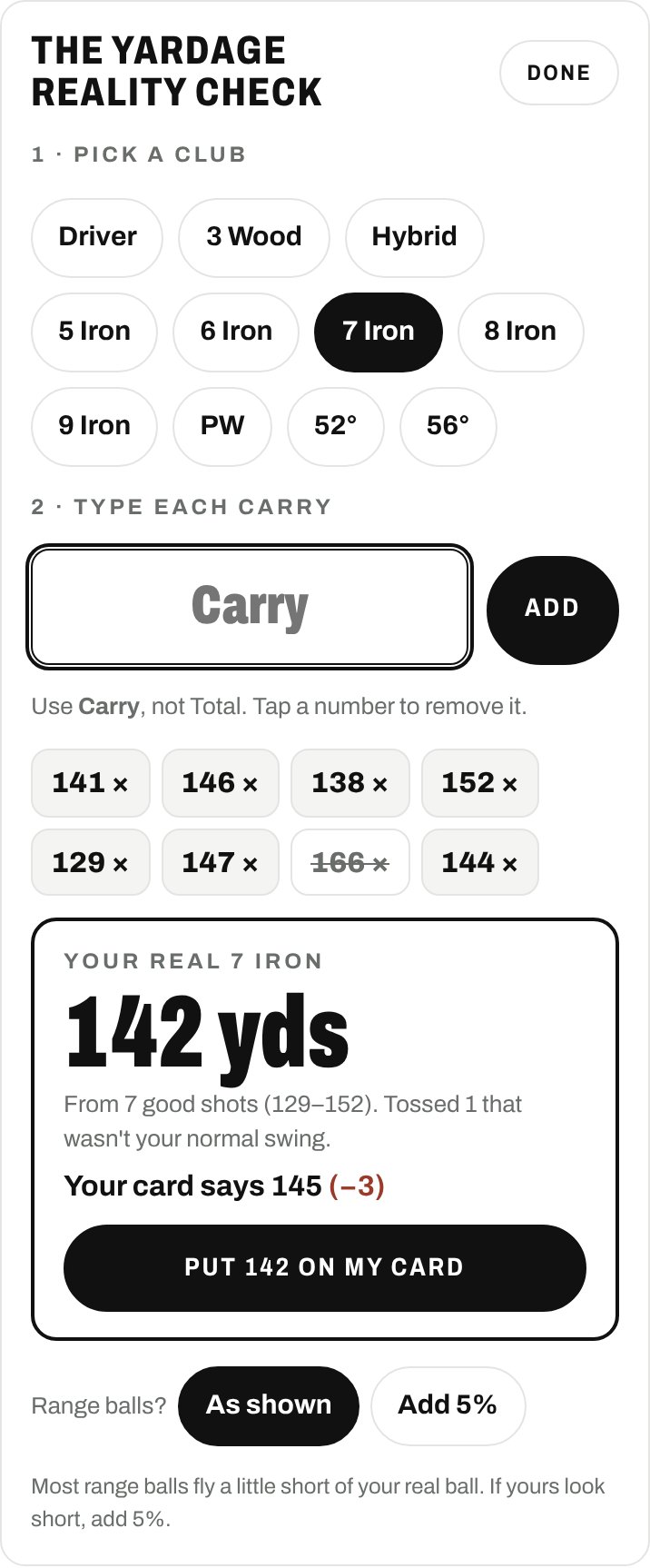
What it does
- The Yardage Reality Check. At a Topgolf bay, Toptracer range, launch monitor or simulator, hit 5 to 10 balls with one club and type in each carry. Pete tosses the flukes and gives you your real number. No more guessing off a sign.
- Pete's Yardage Card. Enter your carry for each club, type the yards to your target, and Ask Pete picks the club for wind, hills and rough. Print it as a pocket card.
- Ask Pete on the hole screen. Once your bag is set up, Ask Pete also shows up while you keep score on the course.
What it doesn't do
- It doesn't track your shots on its own. No sensors, no GPS yardages. You type the numbers in from the screen at your bay.
- It doesn't teach your swing. Neither does this blog.
- It doesn't book range time or simulator bays. Call the range for that.
What's your real number? Type in your carries from the bay screen, and Pete gives you a number you can trust. Free, in your phone's browser. Try the Reality Check
Driving range FAQ
Do I need to bring my own balls to the driving range?
No. You buy range balls there. For the putting green and chipping area, you usually bring your own.
What size bucket should a beginner buy?
A small one. You'll practice better with fewer balls and more time between shots.
Can I go get a ball that rolled off my mat?
No. Never walk out onto the range. Let it go.
Do I need my own clubs at the range?
It helps, but many ranges rent clubs or lend a few. Call ahead.
Is Topgolf a good place for a beginner?
Yes, if you want a relaxed first try. It's busier and louder than a regular range, but nobody minds a beginner.
Should I warm up before a round?
If you have time, a few range balls and 5 to 10 minutes of putting help a lot. If you're short on time, putt.
Can I practice on the course before a tournament?
In stroke-play competitions, generally not on the competition course that day. The range and practice greens are fine.

Pete's Beginner's Guide to Golf: 110 pages on tee times, etiquette, the rules you'll actually use, the lingo and keeping score. Free when you join the Legend List.
Free PDF. Confirm your email to get the book. Unsubscribe anytime. Privacy · Rather hold it? Paperback and Kindle are on Amazon.More from Pete's Blog: Your first time at a golf course · What do you actually need to start golf? · The golf rules you'll actually use · Golf etiquette and pace of play · Scrambles, best ball and other formats · How is a golf course laid out? · What's a good golf score? · How to keep score in golf · Skins and Nassau, explained · How far should you hit each club? · How is a golf handicap calculated? · What's a snowman in golf?
IF YOU KNOW, YOU GOLF.