

Pete saysNobody explains the course to new golfers. They just hand you a cart key and point. That's how I spent my first round looking for the 150 marker on the wrong hole.
The five areas of the course
The Rules of Golf split every course into five areas. Learn these and the rest of the game makes a lot more sense.
| Area | What it is | What it looks like |
|---|---|---|
| Teeing area | Where you start each hole | A flat spot with two tee markers |
| General area | Everything that isn't one of the other four | Fairway, rough, trees, paths, the fringe |
| Bunkers | Prepared areas of sand | The sand traps |
| Penalty areas | Water and other areas the course marks red or yellow | Ponds, creeks, ditches, sometimes thick brush |
| Putting green | The short grass around the hole you're playing | The green, with the flag |
Here's the part that surprises people. The fairway and the rough aren't separate areas in the rulebook. They're both part of the general area, and the same rules apply in each. The rough just makes it harder.
Now let's walk a hole from start to finish.
The tee box (teeing area)
Every hole starts at the tee box. You'll see two tee markers, usually small blocks or balls, sitting on the grass. You tee your ball up between them.
The rule is simple. The teeing area is a box that starts at the line between the front of the two markers and runs two club-lengths back. Your ball has to be inside that box. You can stand outside it, but the ball can't be in front of the markers.
Tee colors
Most courses have several sets of tees on each hole, each a different color. The farther back the tees, the longer the course.
There's no official color code. Every course picks its own. A common setup looks something like this, from longest to shortest:
| Common color | Usually… |
|---|---|
| Black or blue | The back tees. The longest course. |
| White | The middle tees. Where a lot of regular golfers play. |
| Gold or green | Shorter tees. Often for seniors or newer golfers. |
| Red | The forward tees. The shortest course. |
The scorecard tells you the truth. Each set of tees gets its own row with the yardage for every hole and the total for the round. Some courses also list a different par for some holes from the forward tees. Read the card, not the color.
Which tees should you play?
Play the tees that give you a fair shot at reaching the green. For a beginner, that almost always means a shorter set than you think.
In 2011, the USGA and the PGA of America started a program called Tee It Forward to get golfers to move up. Their guideline matched how far you hit your driver to how long the whole course should be:
| Your average drive | Recommended 18-hole length |
|---|---|
| 250 yards | 6,200 to 6,400 yards |
| 225 yards | 5,800 to 6,000 yards |
| 200 yards | 5,200 to 5,400 yards |
| 175 yards | 4,400 to 4,600 yards |
| 150 yards | 3,500 to 3,700 yards |
Find your drive in the left column, then find the tees on the scorecard whose total matches the right column. Not sure how far you really hit it? Read How far should you hit each club? before you trust the number in your head.
Here's how it played out for three Buddies:
- Dale drives it about 225. The card shows the white tees at 6,050 yards and the gold tees at 5,600. He plays the whites, the closest match.
- Rhonda drives it about 200. The forward tees are 5,100 and the golds are 5,600. She plays the forward tees.
- Big Mike drives it about 200 and plays the back tees "because that's where the real golfers play." He shot 112 and lost three balls. Move up, Big Mike.
Nobody cares which tees you play. Everybody cares if you take six hours.

Pete saysThe back tees are for people with something to prove. I proved it once. It took five and a half hours and a sleeve of balls.
Fairway, rough, fringe and green
Once you're off the tee, here's the grass you'll see.
| Part of the hole | What it looks like | Why it matters |
|---|---|---|
| Putting green | The shortest, smoothest grass, with the hole and flag | Special rules apply here. You can mark and lift your ball and fix ball marks. |
| Fringe (or apron, or collar) | A thin strip of slightly longer grass around the green | It's not part of the green. It's general area. You can still putt from it. |
| Fairway | Short grass running from the tee toward the green | The target off the tee. Easiest place to hit from. |
| Rough | Longer grass on both sides of the fairway | Harder to hit from, easier to lose a ball in. |
The fringe trips up beginners. Your ball is only "on the green" if part of it touches the putting green itself. On the fringe, the green rules don't apply yet, so you can't mark and lift it like you can on the green.
Bunkers
A bunker is a prepared area of sand. Some sit along the fairway (fairway bunkers). Most sit around the green (greenside bunkers).
Two things to know:
- Bunkers have a few extra rules. The main one: don't touch the sand with your club right before your shot, or on your practice swing. The rules you'll actually use get their own chapter.
- Rake it when you leave. There's usually a rake nearby. Smooth out your footprints and the spot where your ball was. The next person will thank you.
Some courses also have big sandy waste areas. Those usually aren't bunkers in the rulebook; they're general area, so the bunker rules don't apply. If you're not sure which is which on a course, check the scorecard or ask in the pro shop.
White, red and yellow stakes and lines
This is the part that confuses everybody, and it matters, because it can cost you strokes. The Rules of Golf say what each color means.
| Color | What it marks | What happens if you go there |
|---|---|---|
| White | Out of bounds. The edge of the course. | 1 penalty stroke, and you play again from where you just hit. |
| Red | A red penalty area | 1 penalty stroke, with three ways to take relief, including dropping to the side. |
| Yellow | A yellow penalty area | 1 penalty stroke, with two ways to take relief. No dropping to the side. |
Out of bounds vs. a penalty area
These look similar from the cart. They're not.
- Out of bounds means off the golf course. Your ball is gone. You add one penalty stroke and go back to where you hit it from. That's called stroke and distance.
- A penalty area is still on the course. It's usually water, but the course can also mark brush, desert or other rough country this way. You add one penalty stroke, but you usually don't have to walk back. You drop a ball outside the area and keep going.
A few details that matter:
- On a white line, the line itself is out of bounds. But your ball is only out if all of it is past the course side of the line. If any part of it is still on the course side, it's in bounds.
- The stakes and lines of a penalty area are part of the penalty area.
- Unmarked water still counts. Any body of water on the course is a penalty area even if nobody marked it. If the course didn't say what color it is, treat it as red.
How to count those penalty strokes, step by step, is in How to keep score in golf. That post also covers the "take two" drop some courses allow for a lost ball or out of bounds.
Pete saysWhite means gone. Red means wet, with options. Yellow means wet, with fewer options. Big Mike has seen all three on one hole.
Yardage markers: how far you have left
Most courses help you figure out how far you are from the green. Here's what to look for.
The 100, 150 and 200-yard markers
Many courses put markers along the fairway or the edge of the rough. They might be short posts, small bushes, or round plates set in the middle of the fairway. Colors and styles vary from course to course, but a common system is:
| Marker | Common color |
|---|---|
| 200 yards | Blue |
| 150 yards | White |
| 100 yards | Red |
These distances are usually measured to the center of the green, but some courses measure to the front. The scorecard or the starter can tell you which.
Sprinkler head yardages
Look down. Many courses print a number on the sprinkler heads in the fairway. That number is the yardage from that sprinkler head to the green, usually to the center, though some courses measure to the front edge. Ask if you're not sure.
Sprinkler heads are the best yardage on a course without GPS, because there are so many of them. Find the closest one, then pace off the difference to your ball.
Reading a hole's yardage
The number on the scorecard is the length of the whole hole, from the tee to the green, along the way the hole is meant to be played. It's not a straight line if the hole bends.
Here's how Rhonda works it out on a par 4:
- On the tee. The card says 340 yards from her tees. She hits it into the fairway.
- In the fairway. She's just past the 150 marker. She guesses about 10 yards past it, so about 140 to the center.
- Look at the flag. At this course a red flag means the hole is cut toward the front of the green (more on flag colors below). That plays a little shorter than 140.
- Pick the club. She picks the club she really hits about that far. Not the one she hit that far once in 2022.
Flag colors (where courses use them)
Some courses use the color of the flag to tell you where the hole is cut on the green. There's no standard, and plenty of courses use one color for every flag. A common system is:
| Flag color | Hole position |
|---|---|
| Red | Front of the green |
| White (or yellow) | Middle of the green |
| Blue | Back of the green |
Some courses use a small marker on the flagstick instead, set high or low to show front or back. If the color isn't explained on the card or in the cart, ask the starter. It's a normal question.
Doglegs and other hole shapes
Not every hole is straight.
- Dogleg left: the hole bends to the left partway down.
- Dogleg right: the hole bends to the right.
- Double dogleg: it bends one way, then the other. Usually a par 5.
On a dogleg, you usually can't see the green from the tee. Look for a sign on the tee box with a map of the hole, if the course has one. It shows the bend, the bunkers and the water.
The safe play on a dogleg is to aim for the corner of the bend, where the fairway turns. Cutting the corner over the trees is how good holes turn into stories.
Pete saysA dogleg is golf's way of asking, "Are you sure?" I usually wasn't.
Par 3s, par 4s and par 5s
Every hole has a par, printed on the scorecard. It's mostly about length.
| Par | What it usually means |
|---|---|
| Par 3 | A short hole. A good player reaches the green with the tee shot. |
| Par 4 | A medium hole. A good player reaches the green in two shots. |
| Par 5 | A long hole. A good player reaches the green in three shots. |
Most 18-hole courses have a mix, with a total par around 70 to 72. A 9-hole course is often around 35 or 36. Your total is compared to that number. The names for scores above and below par, like birdie and bogey, are in How to keep score in golf. The one nobody wants, the 8, has its own post: What's a snowman in golf?
The scorecard is your map
Before you tee off, read the card. It tells you:
- The yardage of every hole from every set of tees.
- The par for every hole, and sometimes a different par from the forward tees.
- The handicap row, which ranks the holes from hardest to easiest. More on that in How is a golf handicap calculated?
- The course rating and slope for each set of tees.
- Local rules, often printed on the back. These tell you anything special about that course.
A little history
The push to get regular golfers on shorter tees is real and recent. The Tee It Forward chart earlier in this post came from Barney Adams, a longtime golf club designer. The USGA's point: for an average golfer, a 6,700-yard course plays about like an 8,100-yard course would for a tour pro. That's far longer than anything the pros play.
So if moving up feels like cheating, it isn't. It's what the people who write the rules asked you to do.
How the Pete Scorecard helps
The Pete Scorecard runs in your phone's browser. No download, and no account needed to keep score.
What it does
- Finds your course. Search the course database, or add a course by hand. If a par looks wrong, send a "Wrong par?" report.
- Handles women's tees. A player set to women's tees is scored against the course's women's pars.
- Par is already filled in, so a par is one tap. Play 9 or 18 holes, with up to 4 players on one phone.
- Works with no signal, which is handy on the back side of a lot of courses. You can add it to your Home Screen like an app.
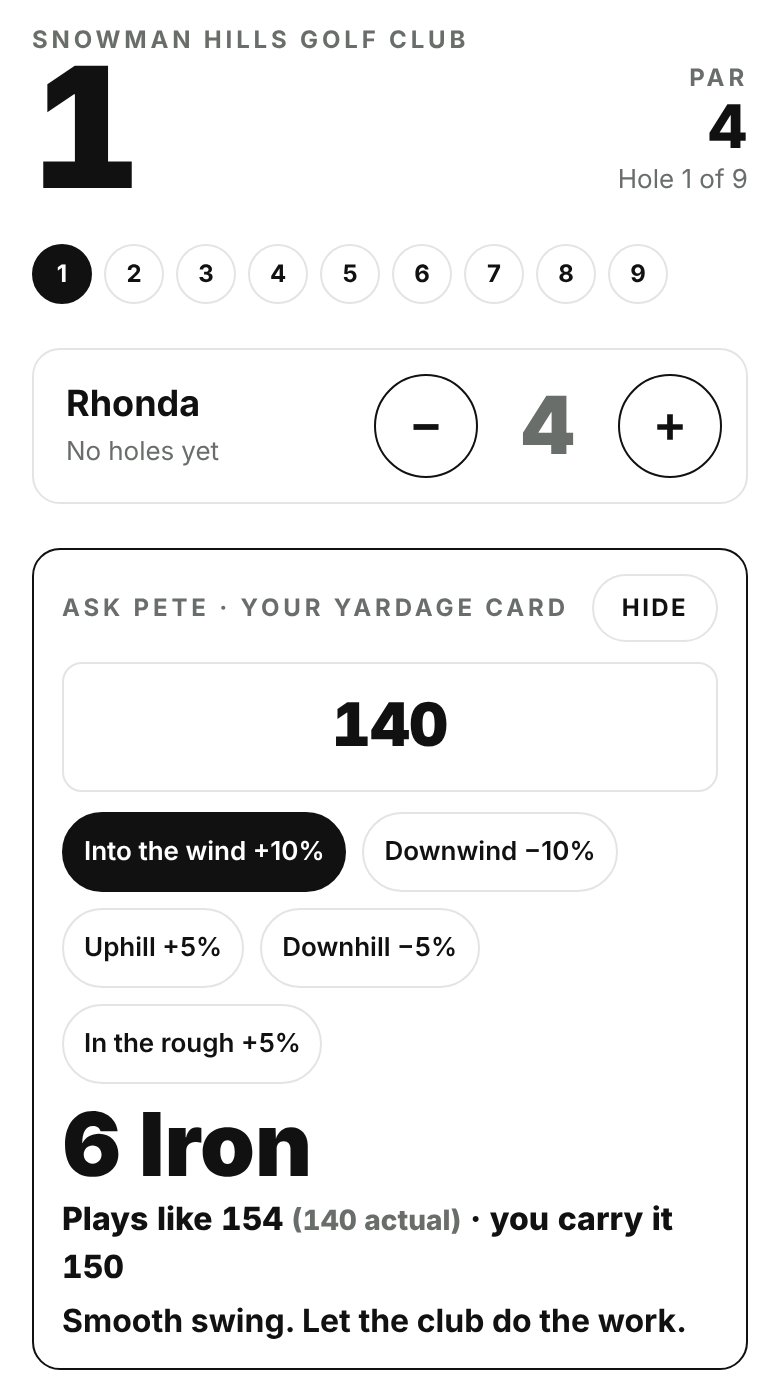
- Pete's Yardage Card. Enter your carry distances, type the yards you read off the marker or sprinkler head, and Ask Pete picks the club for wind, hills and rough. Once your bag is set up, Ask Pete shows on the hole screen too. You can also print a pocket card.
- The Yardage Reality Check. Not sure of your numbers? Hit 5 to 10 balls with a club at a Topgolf bay, a Toptracer range, a launch monitor or a simulator. Type each carry, and Pete tosses the flukes and gives you your real number.
What it doesn't do
- No GPS yardages. It doesn't know where you're standing. You read the yards off the marker or sprinkler head and type them in.
- No course maps. It won't show you the dogleg. Look for the sign on the tee.
- No separate tee boxes yet. It doesn't keep blue, white and gold yardages or ratings for each set of tees.
- No tee-time booking. Call the course or use its website.
Let Pete pick the club. Find your course, play the right tees, and keep score in your phone's browser for free. No download, no sign-up. Keep score free
Golf course layout FAQ
What do the different tee colors mean?
They're different lengths of the same course. The back tees are the longest and the forward tees are the shortest. There's no national color code, so check the scorecard for each set's yardage.
Which tees should a beginner play?
Usually a shorter set than you think. The USGA and PGA of America's Tee It Forward chart says a golfer who drives it about 200 yards should play a course of about 5,200 to 5,400 yards.
What do white, red and yellow stakes mean in golf?
White is out of bounds. Red and yellow mark penalty areas, usually water. Both penalty areas cost one stroke, but red gives you an extra option to drop to the side.
What's the difference between out of bounds and a penalty area?
Out of bounds is off the course. You take a penalty stroke and go back. A penalty area is on the course. You take a penalty stroke and usually drop nearby.
Are yardage markers to the front or middle of the green?
Usually the middle, but not always. Check the scorecard or ask the starter at that course.
What do the flag colors mean?
At courses that use them, they often show where the hole is cut: commonly red for the front, white or yellow for the middle and blue for the back. Not every course does this.
Is the fringe part of the green?
No. The fringe is part of the general area. You can putt from it, but you can't mark and lift your ball there like you can on the green.
More from Pete's Blog: What's a good golf score? · How to keep score in golf · Skins and Nassau, explained · How far should you hit each club? · How is a golf handicap calculated? · What's a snowman in golf?
IF YOU KNOW, YOU GOLF.