

Pete saysAsk ten guys at the bar how far they hit their 7 iron and you'll hear "150" nine times. The tenth guy says 160, and he's lying too. I said 150 for years. Then I hit balls on a launch monitor and found out I'd been lying to myself.
What golfers really hit
Most "average distance" charts online come from pros, or from a launch monitor in a perfect bay. Neither one is you on the 7th hole after a hot dog. The numbers below come from Shot Scope, which tracks real shots from amateurs on real courses. They're total distance (carry plus roll) for male golfers, sorted by handicap.
| Club | 25 hcp | 20 hcp | 15 hcp | 10 hcp | 5 hcp | Scratch |
|---|---|---|---|---|---|---|
| Driver | 204 | 225 | 236 | 259 | 261 | 285 |
| 3 wood | 178 | 195 | 215 | 227 | 234 | 261 |
| Hybrid | 162 | 180 | 197 | 214 | 216 | 237 |
| 5 iron | 143 | 162 | 169 | 187 | 183 | 200 |
| 6 iron | 137 | 151 | 162 | 171 | 172 | 185 |
| 7 iron | 132 | 146 | 154 | 161 | 164 | 178 |
| 8 iron | 122 | 138 | 146 | 150 | 153 | 166 |
| 9 iron | 108 | 129 | 136 | 140 | 139 | 155 |
| Pitching wedge | 90 | 108 | 121 | 127 | 126 | 141 |
| Gap wedge | 79 | 94 | 104 | 110 | 109 | 126 |
Source: Shot Scope on-course data for male golfers, as published by Golf Monthly and MyGolfSpy. A few rows don't step down perfectly from one handicap to the next. That's real data for you.
For women, the same data has the average 11–15 handicap hitting driver about 199 yards and a 7 iron about 141.
Look at the 7 iron row. The average 20-handicap hits it 146 yards with the roll. If you're a weekend golfer who says 150 through the air, you're probably giving yourself 10 yards you don't have. That's the gap between the middle of the green and the front bunker.
Your "stock" number isn't a promise
Here's the part nobody likes. Shot Scope also looked at how often golfers hit their 7 iron within 5 yards of their own average. A 15-handicap does it about 14% of the time. Scratch golfers? Only about 18%.
So even your real number is the middle of a range, not a laser. That's why the fat part of the green is your friend, and why the pin tucked behind the bunker is somebody else's problem.

Pete saysGolf is the only sport where everybody remembers their best shot as their normal shot. Your buddy hit one 7 iron 165 in 2019 downwind off a cart path. He's been hitting "165" ever since.
Why everybody thinks they hit it farther
- You remember the good ones. The flushed 7 iron stays in your head for years. The thin one that came up 20 short doesn't.
- Total vs carry. A ball that carries 140 and bounces 12 feels like a 150-yard shot. But it was 140 over the bunker.
- Range numbers lie both ways. Range balls usually fly a little shorter than your real ball. Hitting off a perfect mat flies a little better than hitting out of a divot.
- Lofts got stronger. Plenty of today's 7 irons carry the loft a 6 iron used to. A "7 iron" with a lot less loft goes farther, so your number may not match your buddy's even with the same swing.
Carry vs total: which one to use
Carry is how far the ball flies in the air. Total adds the roll after it lands.
- Into a green, use carry. You're flying it over a bunker, water or the front edge. The roll is a bonus.
- Off the tee, total matters more. That's where the ball ends up for your next shot.
Most launch monitors and range screens show both. Write down the carry.
How to find your real numbers
- Find a tracker. A Topgolf bay, a range with Toptracer, a launch monitor or a golf simulator. Anything that shows carry on a screen.
- Hit 5 to 10 balls with one club. Normal swing, not your hero swing. Write down the carry of every shot.
- Toss the flukes. The chunk that went 90 and the one-in-a-hundred bomb don't count. Average the rest.
- Do the next club. Work through the bag. A bucket of balls is enough for most of it.
- Check your gaps. Irons are usually about 8 to 15 yards apart. Two clubs that go the same distance? You only need one. A 20-yard hole between two clubs? That's where a hybrid or an extra wedge earns its spot.
No tracker nearby? On the course, use a rangefinder or the sprinkler heads to see how far your shots actually went. Note it for a few rounds and the pattern shows up fast.
Let Pete do the math (no scorecard needed)
All of this is built into Pete's Yardage Card. It's free, runs in your phone's browser, and you don't have to keep score to use it.
1. Find your real numbers with the Reality Check
At the range or a Topgolf bay, pick a club and type in the carry of each shot. Pete tosses the shots that weren't your normal swing, averages the rest, and tells you your real number. One tap puts it on your card.
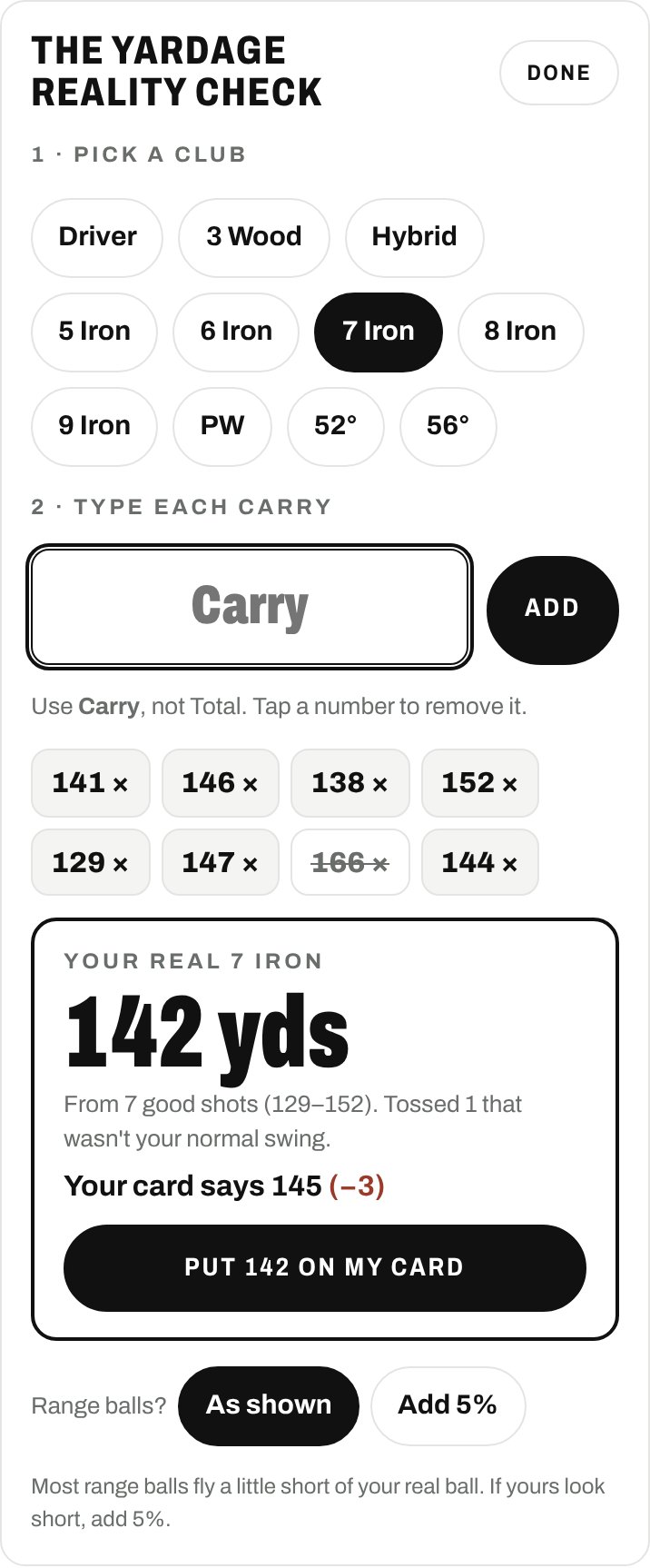
Range balls flying short? There's an "Add 5%" button for that.
2. Ask Pete what to hit
On the course, type the yards to the pin and tap whatever's going on: into the wind, downwind, uphill, downhill or in the rough. Pete works out what the shot plays like, picks the club from your numbers, and tells you if you're between clubs.
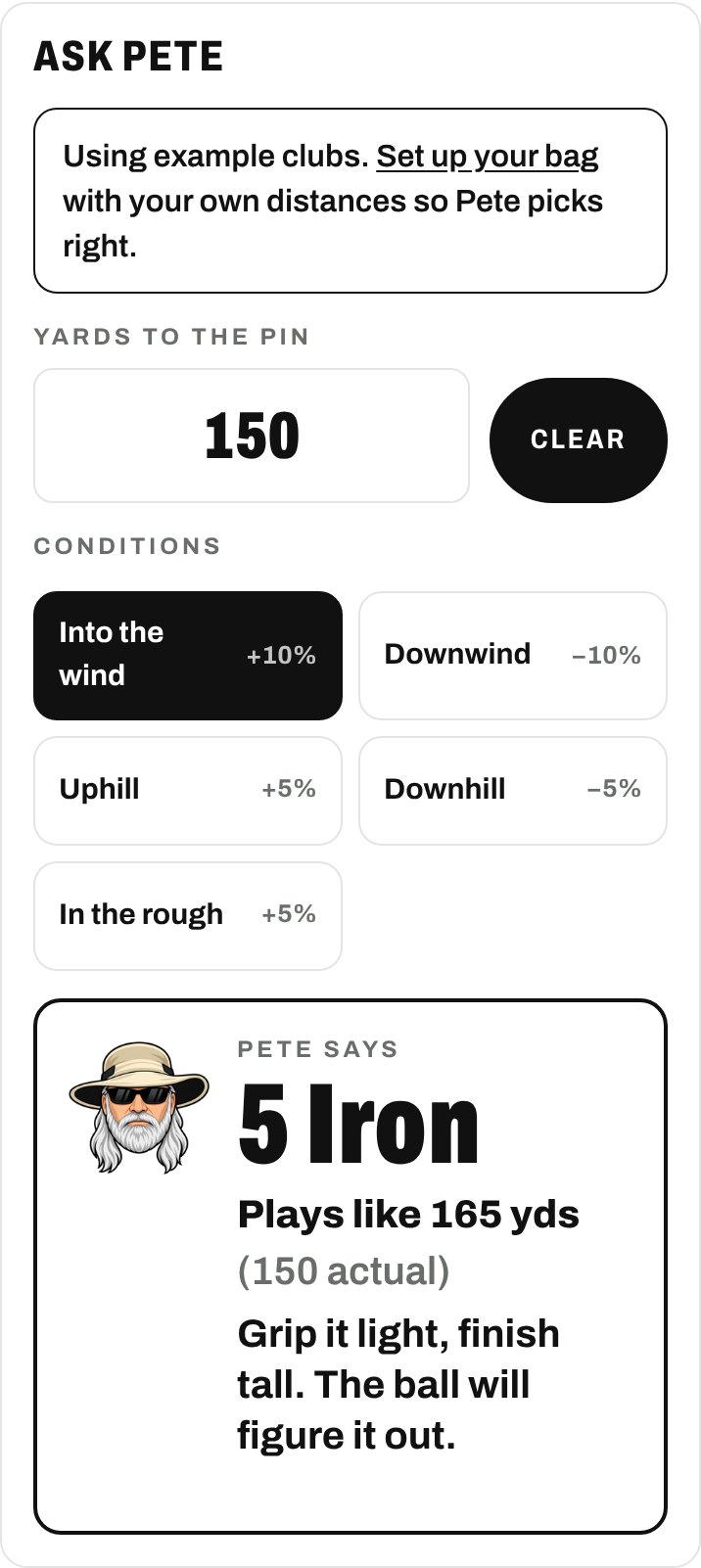
Pete's rules of thumb:
| Condition | Pete adds or takes off |
|---|---|
| Into the wind | +10% |
| Downwind | −10% |
| Uphill | +5% |
| Downhill | −5% |
| In the rough | +5% |
They're rules of thumb, not physics class. A gale or a cliff needs more. But they'll get you closer than "eh, I'll swing harder."
3. Take it with you
- Print a pocket card for your bag, or save it as a picture on your phone.
- If you keep score with the Pete Scorecard, "How far? Ask Pete" shows up on every hole once your bag is set up.
Your real numbers. Add your clubs, type the yards, and Pete picks the club for wind, hills and rough. No download, no sign-up, and no scorecard needed. Ask Pete
Club distance FAQ
How far should I hit my 7 iron?
On-course data from Shot Scope puts the average male 15-handicap at about 154 yards total, a 20-handicap at about 146 and a 25-handicap at about 132. For women, an 11–15 handicap averages about 141. But the only number that helps you is your own, so measure it.
Should I use carry or total distance?
Carry for approach shots, because you're usually flying something: a bunker, water or the front of the green. Total matters more off the tee.
How many yards apart should my clubs be?
Usually about 8 to 15 yards between irons. If two clubs go the same distance, you only need one of them. A gap of 20 yards or more is worth filling.
Why do I hit it shorter on the course than at the range?
Mats, perfect lies, no pressure and one club over and over. On the course you've got slopes, rough, cold mornings and a group watching. Use your on-course or tracker carry numbers, not your best range day.
Do I need the scorecard to use Pete's club picker?
No. Pete's Yardage Card works on its own at scores.punkheadpete.com/yardage. If you do keep score with the Pete Scorecard, Ask Pete shows up on the hole screen too.
IF YOU KNOW, YOU GOLF.