

Pete saysMy first round, I wrote down what I meant to shoot. My Buddies wrote down what I actually shot. Their card was right. Their card is always right.
What a golf scorecard looks like
Every scorecard looks a little different, but they all have the same bones. Here's what you'll find on most of them.
| Row | What it means |
|---|---|
| Hole | 1 through 9 is the "front nine." 10 through 18 is the "back nine." |
| Tees (yardage) | One row per set of tees, with the length of each hole. Play the same tees all day. |
| Par | The score a good player is expected to make on that hole. Usually 3, 4 or 5. |
| Handicap (or stroke index) | Ranks the holes from 1 (hardest) to 18 (easiest). Only matters if you're giving or getting strokes. |
| Player rows | Blank boxes where you write each golfer's score, hole by hole. |
| OUT / IN / TOT | Totals for the front nine (OUT), the back nine (IN) and the full 18 (TOT). |
| HCP / NET | Your handicap strokes and your score after taking them off. |
| Marker / Attest | Where the person keeping your score signs off. Mostly for tournaments. |
You'll also see a course rating and a slope rating next to each set of tees. Those are for handicaps, not for keeping score. We covered them in How is a golf handicap calculated?
How to count strokes
The rule is simple. Every time you swing at the ball trying to hit it, that's a stroke. Tee shots, chips, putts, the one that went 4 feet. All of them.
- Tee shot. That's 1.
- Every shot after that. Add 1 each time.
- Every putt. Putts count the same as drives. A 2-foot putt and a 280-yard drive are both 1 stroke. Golf is not fair, and it never said it was.
- The ball goes in the hole. Stop counting. Write it down.
Yes, the whiff counts
If you swing to hit the ball and miss it completely, that's a stroke. The Rules of Golf define a stroke as "the forward movement of the club made to strike the ball." Missing doesn't undo it.
What doesn't count:
- Practice swings. As long as you weren't trying to hit the ball, they're free.
- A swing you stop on purpose before the club reaches the ball.
- Knocking the ball off the tee by accident before you've made a stroke. Put it back on the tee. No stroke, no penalty.

Pete saysThe whiff is the only shot in golf where everybody saw it and nobody says a word. Then they all write it down.
Penalty strokes: the ones that sneak up on you
Penalty strokes get added to your score on top of the shots you actually hit. These are the big three for beginners.
| What happened | Penalty | What you do |
|---|---|---|
| Out of bounds (past the white stakes or line) | 1 stroke | Play again from where you just hit. This is called "stroke and distance." |
| Lost ball (not found within 3 minutes of starting to look) | 1 stroke | Same as out of bounds: stroke and distance. |
| Water or penalty area (red or yellow stakes or lines) | 1 stroke | Take relief using one of the options for that area, such as dropping back on a line from the hole through where the ball last crossed into it. |
Out of bounds, step by step
This is the one that confuses everybody, so let's count it out.
- You hit your tee shot out of bounds. That's 1.
- Add the penalty. That's 2.
- You tee it up again and hit. That's 3.
So your second ball off the tee is your third shot. That's why golfers say "hitting 3 off the tee." If it finds the fairway and you get it on the green in 2 more and two-putt, you made a 7.
Tip: if you think your ball might be lost or out of bounds, hit a provisional ball before you walk up. Say "I'm hitting a provisional" so your group knows. If the first ball turns up in bounds, you play it and forget the provisional. If not, you're already playing the provisional, and you didn't have to walk back.
The "drop it where it went out, take two" option
Some courses use an official Local Rule, called E-5, for a lost ball or a ball out of bounds. Instead of walking back, you add 2 penalty strokes and drop near where the ball was lost or went out, anywhere from there over to the edge of the fairway, no closer to the hole. Lose your tee shot and you're hitting your 4th from the drop. Same score as going back and hitting 3 off the tee, just without the walk.
It's only in play if the course has adopted it, so check the scorecard or ask in the pro shop. Plenty of casual groups play it too. Agree on it at the first tee. Two catches: it doesn't work for a ball in the water, and once you've hit a provisional, you play the provisional.
Water, step by step
- Tee shot goes in the pond. That's 1.
- Add the penalty and take your drop. That's 2.
- Your next shot from the drop. That's 3.
Water costs you one stroke. Out of bounds costs you one stroke plus the distance, because you have to go back. Same penalty number, very different walk.
Par, birdie, bogey and the rest
Once you have your number, golf gives it a name based on how it compares to par.
| Score vs. par | Name | On a par 4, that's a… |
|---|---|---|
| −3 | Albatross (or double eagle) | 1 (a hole-in-one on a par 4. Rare air.) |
| −2 | Eagle | 2 |
| −1 | Birdie | 3 |
| 0 | Par | 4 |
| +1 | Bogey | 5 |
| +2 | Double bogey | 6 |
| +3 | Triple bogey | 7 |
| +4 | Quadruple bogey | 8 (also a snowman) |
A hole-in-one on any hole is an ace. An 8 on any hole is a snowman, and it got its own post: What's a snowman in golf?
Your score for the round is usually said compared to par too. Shoot 80 on a par-72 course and you're "8 over." Shoot 70 and you're "2 under," and you should probably be writing this blog instead of reading it.
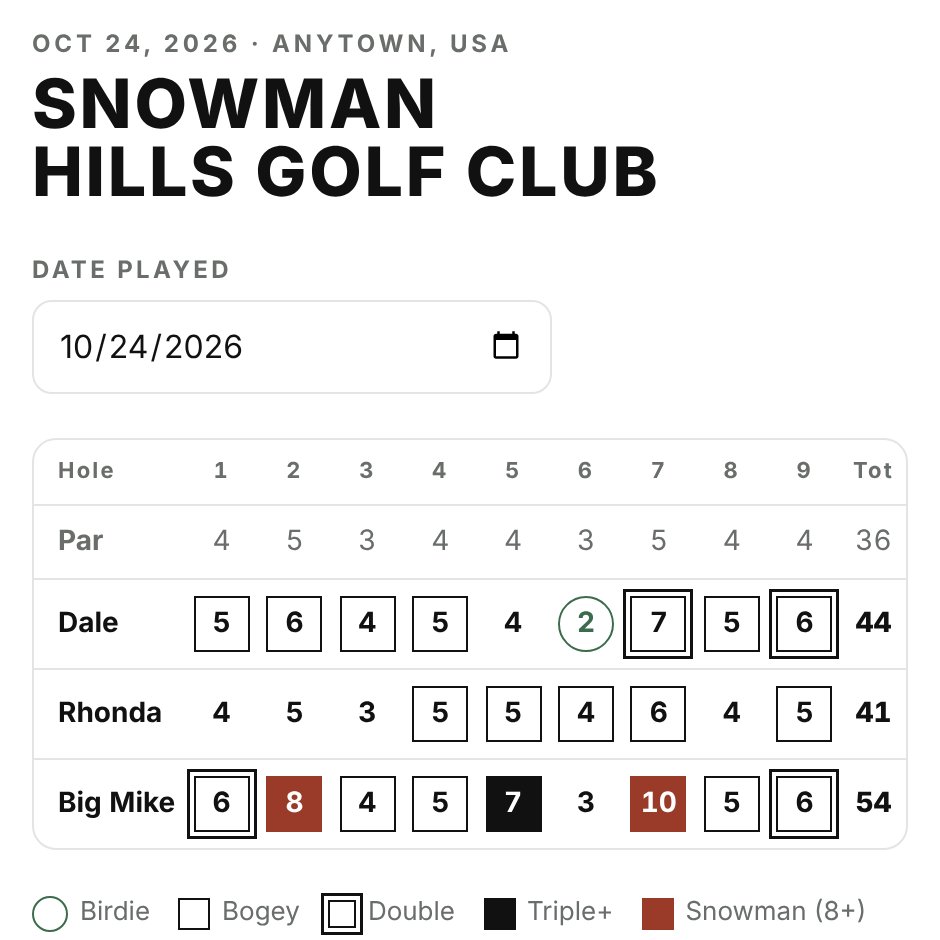
Let's run one: a 9-hole card
Three Buddies play the front nine. Par is 36.
| Hole | 1 | 2 | 3 | 4 | 5 | 6 | 7 | 8 | 9 | OUT |
|---|---|---|---|---|---|---|---|---|---|---|
| Par | 4 | 5 | 3 | 4 | 4 | 3 | 5 | 4 | 4 | 36 |
| Handicap | 7 | 3 | 9 | 1 | 5 | 8 | 2 | 6 | 4 | |
| Dale | 5 | 6 | 4 | 5 | 4 | 3 | 7 | 5 | 6 | 45 |
| Rhonda | 4 | 5 | 3 | 5 | 5 | 4 | 6 | 4 | 5 | 41 |
| Big Mike | 6 | 8 | 4 | 5 | 7 | 3 | 10 | 5 | 6 | 54 |
Here's what happened on the holes worth talking about:
- Hole 2, Big Mike: 8. Tee shot out of bounds (1), penalty (2), re-tee (3). Three more shots to the green (6) and two putts (8). A snowman, built the honest way.
- Hole 6, Rhonda: 4. She whiffed her tee shot (1). Then she hit the green (2) and two-putted (4). The whiff counts. Rhonda wrote it down herself.
- Hole 7, Big Mike: 10. The group plays "double par max" for pace. He hit 10 on a par 5, picked up, and wrote down 10. Nobody needed to see 11.
- Hole 9, Dale: 6. Tee shot in the pond (1), penalty and a drop (2), approach (3), chip (4), two putts (6). A double bogey with a splash.
Add each row across. Dale shot 45 (9 over). Rhonda shot 41 (5 over). Big Mike shot 54 (18 over). Rhonda wins the gross score by four. Wondering how a 45 stacks up? See What's a good golf score?
Gross vs. net
Gross is every stroke you took. Net is your gross score minus your handicap strokes. Net is how golfers of different skill levels play each other fairly.
Say for these nine holes Dale gets 5 strokes, Rhonda gets 3 and Big Mike gets 9 (based on their unofficial handicaps).
| Buddy | Gross | Strokes | Net |
|---|---|---|---|
| Dale | 45 | 5 | 40 |
| Rhonda | 41 | 3 | 38 |
| Big Mike | 54 | 9 | 45 |
Rhonda wins the gross and the net. Some days it just goes that way.
Where do strokes go? That's what the handicap row is for. A golfer getting 5 strokes on these nine gets one on each of the five holes ranked hardest. Here that's holes 4, 7, 2, 9 and 5 (rated 1, 2, 3, 4 and 5). Real scorecards rank all 18 holes, usually with odd numbers on one nine and even on the other, so check the card before you hand out strokes.
Pete saysBig Mike gets nine strokes and still lost to everybody. I didn't make the rules. I just wrote down the numbers.
Match play vs. stroke play
There are two main ways to score a round, and they count differently.
- Stroke play: add up every stroke for the whole round. Lowest total wins. Every shot matters on every hole. This is what most people mean by "keeping score."
- Match play: you play hole by hole against an opponent. Lower score wins the hole. Whoever wins more holes wins the match. A 10 on one hole only loses you that one hole.
In match play, your opponent can also concede a stroke, a hole or the whole match. That's where "that's good" on a short putt comes from. In stroke play, technically, nothing is "good." You hole everything.
Skins and the Nassau are both scored hole by hole, like match play. Read Skins and Nassau, explained before the money comes out.
Picking up: max-score etiquette for casual rounds
In a tournament, you hole out on every hole. In a casual round with your Buddies, a lot of groups agree on a max score so nobody spends 20 minutes on one hole. Agree on it at the first tee, not on hole 7 when you're already lying 9.
Common choices:
| Max score | What it means | On a par 4 |
|---|---|---|
| Double par | Pick up after twice par. Simple and common. | 8 |
| Triple bogey | A tighter cap that keeps things moving. | 7 |
| Net double bogey | Double bogey plus any handicap strokes you get on that hole. The cap used for handicap scoring. | 6, or 7 if you get a stroke there |
The Rules of Golf even have a format called Maximum Score that works this way. The committee sets the cap, like two times par, a fixed number or net double bogey.
Pete's rules for picking up:
- Write down the max, not a guess. If the cap is 8 and you pick up, it's an 8.
- Pick up when you hit the cap, not before. Picking up at 5 and writing a 5 is a different thing. It's called lying.
- Say it out loud. "I'm out, put me down for an 8." Now everybody knows.
- Bets get settled before the round. If there's money on it, agree whether picked-up holes count as the max or as a lost hole.
Signing the card (attesting)
In a tournament, somebody else keeps your score. That person is your marker. At the end of the round, the marker certifies your hole scores, you certify them too, and you turn in the card. That's called attesting, or signing your card.
The rule that matters: you're responsible for the score on each hole.
- Turn in a hole score higher than you actually made, and the higher score stands.
- Turn in a hole score lower than you actually made, and you're disqualified. (There's an exception if you left off a penalty you didn't know about. Then you get the penalty added, plus 2 more.)
- You're not responsible for adding up the total. That's the committee's job.
On a Saturday with your Buddies, nobody's getting disqualified. But the habit's a good one: check each hole before you leave the 18th green.
Common beginner mistakes
- Forgetting penalty strokes. Out of bounds is 1 stroke plus the walk back. Water is 1 stroke. They go on the card.
- Not counting the whiff. If you swung to hit it, it counts.
- Counting the out-of-bounds re-tee as your second shot. It's your third.
- Skipping putts in your count. Putts are strokes. Every single one.
- Writing down a number at the end of the round. Write it down on every green, or right after you walk off it. "I think I had a 6 on 4" never ends well.
- Forgetting to agree on the max score first. Decide at the first tee.
- Mixing up gross and net. Write the gross on the card. Take the strokes off at the end.
- Feeling bad about the numbers. Every golfer started by writing down big ones. The card isn't a grade. It's just what happened.
A little history
Golf started as a match play game. You played your opponent hole by hole, and the total didn't matter much. Stroke play came later.
- The first Open Championship was played in 1860 at Prestwick in Scotland, as stroke play: three trips around a 12-hole course, 36 holes total. Willie Park Sr. won with 174. That's 58 per trip around twelve holes.
- Medal play. Stroke play is also called "medal play." The story goes that the name comes from the medals clubs handed out to the lowest scorer at their competitions. It's a nice story. Nobody's proved it either way.
- One rulebook. Today the USGA and The R&A write the Rules of Golf together, and they're the same rules worldwide. The biggest modern rewrite took effect in 2019, and they put out a new edition every few years. That rulebook is where everything in this post comes from.
Pete saysHundreds of years, and the rule is still "count every swing and write it down." Golf made the hard part simple and the simple part hard.
How the Pete Scorecard keeps score
The Pete Scorecard runs in your phone's browser. Here's what it does and doesn't do.
What it does
- Par is already filled in, so a par is one tap. Bogey is one tap off that.
- Enter a finished round. Kept a paper card? Type your card in after the round.
- Every 8 or worse is marked in red, and the snowman counter keeps your season total.
- Every birdie gets circled and counted, so the good stuff shows up as loud as the snowmen.
- The whole group, live, with Play together (free account). Everyone scores on their own phone and sees every card. Keeping your own card needs no account.
- An unofficial handicap after 3 rounds, so net scores aren't a guessing game.
- Settle the Bet handles skins, Nassau, stroke play and snowman pays, so nobody does the math in the parking lot.
- The Rounds tab shows every round hole by hole, and the season dashboard shows your nemesis holes and where your strokes go.
What it doesn't do
- It doesn't cap holes for you. It counts every stroke you enter. If your group plays double par max, enter the max yourself.
- It doesn't add penalties for you. It doesn't know you went out of bounds. You count the penalty and tap the right number.
- It's not an official handicap. Its unofficial handicap counts every stroke, with no net double bogey cap, so it can run a little higher after a blowup hole. You can't use it for a club tournament or a sanctioned event.
- It's not a signed tournament card. For an official event, use the card the committee gives you.
Let Pete add them up. The Pete Scorecard runs in your phone's browser. No download, no sign-up, no fee. Par is already filled in, so a par is one tap. Keep score free
Scorekeeping FAQ
Does a whiff count as a stroke?
Yes. If you swung trying to hit the ball, it's a stroke, even if you missed. A practice swing doesn't count, and neither does accidentally knocking the ball off the tee before your shot.
How many strokes is out of bounds?
One penalty stroke, and you play again from where you last hit. Hit your tee shot out of bounds and your next tee shot is your third.
How many strokes is hitting it in the water?
One penalty stroke. Then you take relief using one of the options for that penalty area, usually a drop.
What's the "take two" drop for a lost ball?
That's Local Rule E-5. Two penalty strokes, and you drop near where the ball was lost or went out instead of walking back. It only applies if the course has adopted it or your group agrees on it.
Is there a maximum score on a hole?
In regular stroke play, no. You hole out. In casual rounds, most groups agree on a max like double par. For handicap scoring, the official system caps each hole at net double bogey.
What's the difference between gross and net?
Gross is every stroke you took. Net is gross minus your handicap strokes. On the Pete Scorecard, the handicap behind your net is always unofficial.
Do I have to putt out on every hole?
In stroke play under the Rules, yes. In match play, your opponent can concede your putt. In a casual round, your Buddies decide. Just agree before the first tee.
More from Pete's Blog: What's a good golf score? · What's a snowman in golf? · How is a golf handicap calculated? · How far should you hit each club? · Skins and Nassau, explained
IF YOU KNOW, YOU GOLF.