

Pete saysEverybody at the course had a first round once. Most of them just don't like to talk about it.
New to golf? Get Pete's Beginner's Guide to Golf free. 110 pages on everything about golf except the swing.
The whole day, start to finish
Here's the order things happen. Each step has its own section below.
| Step | What happens | Where |
|---|---|---|
| 1. Book a tee time | You pick a day and a start time | Phone, course website or a booking app |
| 2. Show up early | Park, get your clubs out, put your shoes on | Parking lot and bag drop |
| 3. Check in | Give your name, pay your fees, get a cart | Pro shop |
| 4. Warm up (optional) | Hit a few putts or range balls | Practice green or range |
| 5. Meet the starter | Get the day's rules and your turn on the first tee | First tee |
| 6. Play | Keep up, follow the cart rules, have fun | Out on the course |
| 7. Finish | Shake hands, return the cart | 18th green (or 9th) and cart barn |
Step 1: Booking a tee time
A tee time is your reserved start time. If your tee time is 9:10, your group should be on the first tee, ready to hit, at 9:10. Not in the parking lot at 9:10.
Most courses space groups somewhere around 8 to 10 minutes apart, though it varies.
Three ways to book
| How | Good for | Things to know |
|---|---|---|
| Call the pro shop | Your first time. You can ask questions. | Have your day, time, number of players, 9 or 18 holes, and cart or walking ready |
| The course website | Seeing every open time at once | Many show the price before you book. Some ask for a card. |
| A tee-time booking app | Comparing several courses | Some apps charge a booking fee or have their own cancellation rules. Read them. |
For your first time, call. Tell them it's your first round there. Pro shop staff hear that all the time, and they'll often tell you the easiest times to play.
What to ask when you book
- How much is it, and what's included? Green fee, cart, range balls, or not.
- Is there a dress code? Some courses want collared shirts and no denim. Some don't care.
- What's the cancellation policy? Some courses charge if you no-show.
- How early should we get there?
- When is it slowest? Late afternoon on a weekday is often quieter than Saturday morning.
9 holes or 18?
You don't have to play 18. Many courses let you book 9 holes, and it's a great first round. Half the time, half the walking, half the lost balls.
Some courses only sell 18-hole times on busy mornings, so ask.

Pete saysBooking 9 holes isn't quitting. It's knowing when to leave the party.
Step 2: How early to show up
Plan on getting there about 30 minutes before your tee time your first time. Here's where that time goes:
| Minutes before | What you're doing |
|---|---|
| 30 | Parking, getting clubs out, changing shoes |
| 25 | Checking in and paying at the pro shop |
| 20 | Getting your cart, using the restroom, filling water |
| 15 | A few putts on the practice green (optional) |
| 10 | Driving to the first tee |
| 5 | Meeting the starter and your group |
Want to hit balls at the range first? Add more time. How to use the range without wasting your money is in How do you use a driving range?
Running late? Call the pro shop. They may be able to move you to a later time. Showing up after your tee time and expecting to jump in front of the next group won't win friends.
In official competitions, the Rules of Golf have penalties for starting late. In a casual round, the course just moves on without you. Either way, be early.
Step 3: Checking in at the pro shop
The pro shop is the front desk of the golf course. It's usually in or near the clubhouse, and it sells hats, balls and snacks. More important, it's where you check in.
Walk up and say: "Hi, I've got a 9:10 tee time under Dale." That's it.
They'll usually:
- Find your name on the tee sheet.
- Take payment for the green fee and cart fee.
- Hand you a receipt or cart tag, and sometimes a scorecard and pencil.
- Tell you where the carts are and where the first tee is.
Some courses check you in at a starter's booth or a kiosk instead. If you can't find the check-in spot, ask anyone in a golf shirt with a name tag.
Green fees and cart fees
| Fee | What it is | Things to know |
|---|---|---|
| Green fee | The price to play the course | Changes by day, time, 9 vs. 18 holes and season. Weekends usually cost more. |
| Cart fee | The price to use a golf cart | Sometimes included in the green fee, sometimes separate, sometimes required |
| Range balls | A bucket of practice balls | Sometimes included, usually not |
| Club rental | Borrowing a set of clubs | Many courses rent sets. Call ahead. |
We're not listing prices, because they're all over the map. A small town nine-hole course and a fancy resort course are not in the same zip code, money-wise. Ask when you book.
Discounts to ask about: twilight (late-day) rates, senior rates, weekday rates and 9-hole rates. Not every course offers these, and the age for senior rates varies.
Walking is allowed at many courses, and sometimes it costs less. A pull cart (a little push cart for your bag) is often available to rent. Some courses require carts at certain times.
Step 4: The starter
The starter is the person at or near the first tee who runs the schedule. Think of the starter as the host at a restaurant. They decide who's up next.
The starter might:
- Check your receipt or cart tag.
- Tell you the day's cart rules, like "cart path only today" or "90-degree rule."
- Point out anything special, like a hole that's closed or a temporary green.
- Pair you up with another group if you're not a full foursome.
- Tell you when to go. Don't tee off until they say so.
The starter may also tell you the course's target time for the round. Listen to it. That's what the course expects.
Good questions for the starter:
- "Which tees do most people play?"
- "Anything we should know about the course today?"
- "What's the pace you're looking for?"
Which tees to play is covered in How is a golf course laid out?
Some courses also have a ranger or marshal who drives around during the day. They keep pace moving and help with problems. If one rolls up and says you're behind, they're not being mean. Speed up.
Step 5: Getting paired with strangers
If you book as a single, a twosome or a threesome, the course may put other players in your group to make a foursome. This is normal, especially on busy days.
It feels scary the first time. It almost never is.
What to expect
- Introduce yourself. First names are fine. "I'm Dale. First time here."
- Tell them you're new. One sentence: "I'm pretty new, so I'll pick up if I'm slowing us down." That buys you a lot of patience.
- Ask how they're playing. Some groups play ready golf, some take gimmes on short putts. Go with what they do.
- Ride with your own partner if you came as a pair. If you came alone, you may share a cart with a stranger.
What strangers actually care about
| They care about | They don't care about |
|---|---|
| You keeping up | Your score |
| You being quiet while they hit | Your clubs |
| You watching where their ball goes | What you're wearing (within the dress code) |
| You being friendly | Whether you're any good |
Big Mike got paired with two retired guys his first time out. He shot something he won't repeat. They invited him back the next week, because he picked up when he needed to and laughed about it. That's the whole secret.
Want to skip strangers? Book a full foursome. Some courses will still let a twosome go out alone on a slow day. That's up to each course.
Step 6: Cart rules
The Rules of Golf say almost nothing about carts. Cart rules are course policy, and they can change every day based on the weather. Look for signs at the first tee, on the cart, and at each hole, and listen to the starter.
Here are the common ones. Golf etiquette and pace of play covers them in more detail.
| Rule | What it means |
|---|---|
| Cart path only | Keep all four wheels on the paved path all day. Take two or three clubs to your ball. |
| 90-degree rule | Drive the path until you're even with your ball, turn straight out to it, then drive straight back. |
| Stay off tees and greens | Never drive on a tee box or green. Stay outside the ropes, stakes or signs. |
| Stay off the fringe and away from green-side bunkers | Park well back from the green, usually where the path is. |
| Follow the signs | Arrows, ropes and "carts this way" signs tell you where to go. |
A few more
- Don't drive in wet or soggy areas, even when carts are allowed on the grass.
- Park on the side of the green toward the next tee, so you can walk off and go.
- Only as many riders as seats. No standing on the back.
- Some courses have a GPS screen on the cart that warns you or slows the cart near greens. Don't argue with it.
Step 7: What if you're slow?
Every beginner worries about this. Good news: there are simple fixes, and you don't have to suddenly get better.
How to tell you're slow
- There's an open hole in front of you. That's the big one.
- The group behind you is waiting on every shot.
- A ranger tells you.
The goal isn't to race. It's to keep up with the group in front of you.
Fix 1: Pick up
When a hole is going badly, pick up your ball and move on. Many groups use a limit, like double par (an 8 on a par 4).
For a handicap, the World Handicap System already caps what you post on a bad hole at net double bogey, so hacking it out to a 12 doesn't help anyway. The details are in How to keep score in golf and How is a golf handicap calculated?
Rhonda sets her own limit: double par, then she picks up and writes it down. She's never held up a group. She also has a nice collection of 8s, which have their own post: What's a snowman in golf?
Fix 2: Let them play through
If the group behind you is faster and waiting, wave them through.
- Pick a good spot, like a par 3 tee or after your group has hit tee shots.
- Wave them on and step to the side.
- Stay quiet while they hit.
- Go back to playing once they're out of range.
That's not admitting defeat. That's being a good golfer.
Fix 3: Small habits that save time
| Do this | Saves you |
|---|---|
| Be ready when it's your turn | Seconds every shot, which adds up to a lot |
| Take a few clubs when you leave the cart | A walk back to the cart |
| Hit a provisional if your ball might be lost | A long walk back to the tee |
| Look for a lost ball for no more than 3 minutes | The Rules of Golf limit, and your group's patience |
| Write scores at the next tee, not on the green | Holding up the group behind you |
| Play the forward tees | A lot of extra shots |
The Rules of Golf also recommend taking no more than 40 seconds for a shot once it's your turn, and usually less.
Pete saysNobody has ever left the course saying, "That guy picked up too much." Not once.
After the round
- Shake hands on the last green, even with the strangers. Especially with them.
- Take your cart where they tell you (often a cart return or cart barn). Clean out your trash.
- Check that you have all your clubs. Wedges love to get left on the fringe.
- Head to the 19th hole if you like. That's golf talk for the clubhouse bar or grill.
How the Pete Scorecard helps
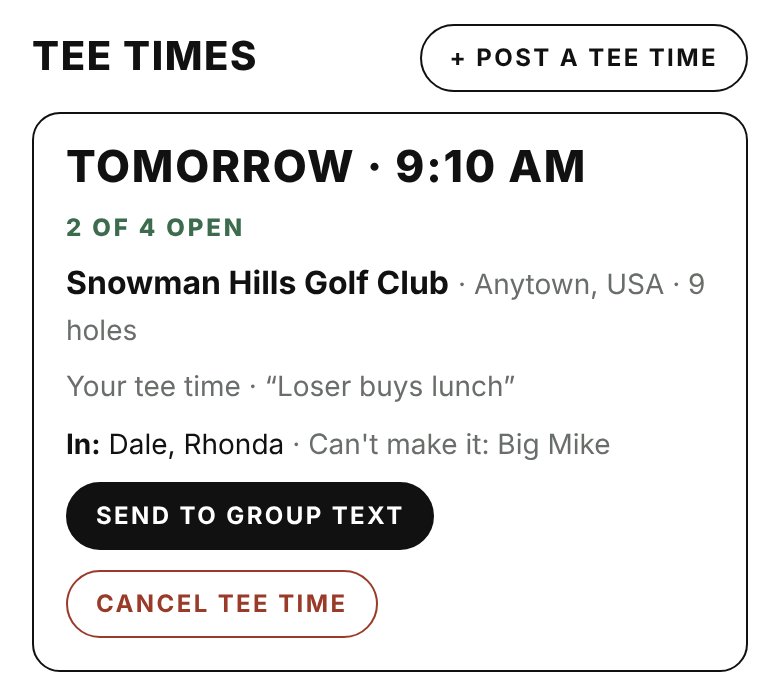
The Pete Scorecard won't book your tee time. It will make the rest of the day easier. It runs in your phone's browser. No download, and no account needed to keep score.
What it does
- Buddies tee times (free account). Post a tee time for your Buddies, and they tap "I'm in" or "Can't make it." No more group text with 40 replies.
- Play together (free account). Your group scores on their own phones and sees the whole group live.
- Works with no signal, so it doesn't matter if the back nine has no bars.
- Add it to your Home Screen like an app, so you're not hunting for it on the first tee.
- Par is already filled in, so a par is one tap. Up to 4 players on one phone.
What it doesn't do
- It doesn't book tee times with courses. Buddies tee times are for your group to say who's coming. You still book with the course.
- It doesn't pay green fees or reserve carts.
- It doesn't give GPS yardages.
Bring a scorecard that keeps up. Get your Buddies in, keep score fast and play even with no signal. No download, and no sign-up to start. Keep score free
First time at a golf course FAQ
How early should I get to the golf course?
About 30 minutes before your tee time the first time. More if you want to hit range balls.
Can I play golf alone?
Yes. Book as a single. The course may pair you with other players, which is normal.
What does a green fee include?
Your right to play the course. Carts, range balls and rentals may or may not be included. Ask when you book.
What does the starter do at a golf course?
The starter runs the first tee, checks you in, gives the day's rules and tells you when to tee off.
Do I have to use a golf cart?
Not always. Many courses let you walk, but some require carts at certain times. Ask the pro shop.
What is the 90-degree rule?
Drive on the path until you're even with your ball, turn straight out to it, then drive straight back to the path.
What if I'm too slow?
Pick up when a hole goes badly, and let faster groups play through. Keep up with the group in front of you.

Pete's Beginner's Guide to Golf: 110 pages on tee times, etiquette, the rules you'll actually use, the lingo and keeping score. Free when you join the Legend List.
Free PDF. Confirm your email to get the book. Unsubscribe anytime. Privacy · Rather hold it? Paperback and Kindle are on Amazon.More from Pete's Blog: What do you actually need to start golf? · The golf rules you'll actually use · Golf etiquette and pace of play · Scrambles, best ball and other formats · How is a golf course laid out? · What's a good golf score? · How to keep score in golf · Skins and Nassau, explained · How far should you hit each club? · How is a golf handicap calculated? · What's a snowman in golf?
IF YOU KNOW, YOU GOLF.