
Pete saysThe golf store wants you to buy everything on day one. Your first round wants you to bring extra balls. Listen to your first round.
New to golf? Get Pete's Beginner's Guide to Golf free. 110 pages on everything about golf except the swing.
The clubs, and what each one is for
Every club is built to send the ball a different distance. Long clubs go far and low. Short clubs go shorter and higher. Here's the lineup:
| Club | What it's for | Does a beginner need it? |
|---|---|---|
| Driver | Tee shots on long holes. The longest club. | Nice to have. Many beginners hit a hybrid or fairway wood off the tee instead. |
| Fairway wood (3 wood, 5 wood) | Long shots from the tee or the fairway | One is plenty. A hybrid can do the job. |
| Hybrid | Long shots that are easier to get in the air than a long iron | Yes, one or two. Very beginner-friendly. |
| Irons (usually 5 through 9) | Medium and shorter shots into the green. Lower number goes farther. | Yes, a few. You can skip the odd numbers to start. |
| Pitching wedge | Short shots into the green | Yes |
| Sand wedge | Getting out of bunkers, and short shots around the green | Yes |
| Putter | Rolling the ball on the green | Yes. You'll use it more than anything else. |
The numbers on irons tell you the order. A 9 iron goes shorter and higher than a 7 iron, which goes shorter than a 5 iron. How far each club goes for real golfers, by handicap, is in How far should you hit each club?
Half set vs. full set
| Half set | Full set | |
|---|---|---|
| How many clubs | About 6 to 8 | Up to 14 |
| Typical mix | Hybrid or wood, a few irons (like 5, 7 and 9), pitching wedge, sand wedge, putter | Driver, woods, hybrids, a full run of irons, several wedges, putter |
| Good for | Learning, a light carry bag, deciding if you like golf | Once you know your distances and want the gaps filled |
| Downside | Some shots fall between clubs | More to buy, more to carry, more decisions |
Plenty of beginners play their first season with a half set and never miss the rest. "Half set" isn't an official term, so check which clubs a set actually includes.
Here's how three Buddies started:
- Rhonda bought a used half set: a hybrid, 6, 8 and pitching wedge, a sand wedge and a putter. She carries it in a light stand bag and walks.
- Dale bought a boxed beginner set with a driver, a wood, a hybrid, irons, a wedge and a putter, plus a bag.
- Big Mike bought a driver he saw on TV before he owned a putter. He borrowed Rhonda's putter for three weeks.
The 14-club limit (Rule 4.1b)
The Rules of Golf say you can't start a round with more than 14 clubs or have more than 14 during the round.
If you break that rule in stroke play, it's two penalty strokes for each hole where you had too many, up to a maximum of four for the round. In match play, it's a deduction of one hole for each hole, up to two holes.
If you find an extra club in your bag during the round, you have to take it out of play right away, before your next shot. Tell your group, or turn it upside down in the bag.
You can start with fewer than 14 and add clubs during the round up to the limit, with some restrictions.
For most beginners this never comes up. But if a Buddy gives you his old hybrid "for your bag," count them.
Pete saysNobody has ever lowered their score by carrying a fifteenth club. Dale tried. It was a second putter.
Used vs. new clubs
Used clubs are a great way to start. You'll find them at golf shops, secondhand sporting goods stores, online marketplaces and garage sales. Clubs don't wear out fast, and a decent used set does everything a beginner needs.
New clubs make sense if you want something set up for your height, or a boxed beginner set with everything matching. Prices vary a lot by store and season, so compare a few.
What to look for in a used set
| Check | What you want | Walk away if… |
|---|---|---|
| Grips (the rubber handle) | Soft and a little tacky | They're slick, cracked or hard. Grips can be replaced, but it adds cost. |
| Shaft flex | A flex that matches your speed (see below) | Every club is marked "X" or "Stiff" and you're new |
| Clubheads | Normal scratches are fine | There are cracks, dents in the face, or the head is loose |
| Shafts | Straight | They're bent, or graphite shafts have deep chips or splinters |
| Matching set | Irons from the same set, in order | It's a random mix with gaps and doubles |
| Length | Fits your height when you stand next to it | They're obviously too long or too short. Ask the shop. |
Shaft flex, in plain words
The shaft is the long part of the club. Flex is how much it bends. Most shafts have a letter on them:
| Letter | Usually means | Usually for |
|---|---|---|
| L | Ladies | Many women and slower swingers |
| A or Senior | Senior or "amateur" | Slower swing speeds |
| R | Regular | Most average golfers |
| S | Stiff | Faster swingers |
| X | Extra stiff | Very fast swingers |
Flex letters aren't standardized between brands. If you're new, Regular or Senior flex is the usual starting point for men, and Ladies or Senior for women. A shop with a launch monitor can tell you more later.
Graphite shafts are lighter, and steel shafts are heavier. Many beginners and seniors like graphite in at least the woods and hybrids. Either is fine to start.
Golf balls
You're going to lose some. That's not a knock on you. It happens to everybody, especially in the first season.
| Type of ball | Good for a beginner? |
|---|---|
| Used or recycled balls | Yes. Sold in bulk at many shops and online. |
| Inexpensive new balls | Yes. Often sold as "distance" or "soft" balls. |
| Premium tour-level balls | Not yet. You'll lose them just as fast. |
Pick one kind and stick with it for a while, so they all feel the same. Then put a mark on each ball with a pen. That way you know which one is yours. Hitting someone else's ball has a penalty, covered in The golf rules you'll actually use.
Bring more than you think you need. A dozen is a good start for a new golfer.
Gloves, shoes and the rest
Glove
Most golfers wear one glove, usually on the left hand for right-handed players and the right hand for lefties. It helps you hold on, especially when it's hot. It's optional. Plenty of people play without one.
Shoes
You don't need traditional golf shoes to start. Spikeless golf shoes have little rubber nubs on the bottom and look like sneakers. They're comfortable to walk in and work fine on the course.
Many courses don't allow metal spikes. Rules vary by course, but spikeless and soft spikes are almost always fine.
If you're only playing a few times, clean sneakers with good grip are often fine. Some courses have a dress code that includes shoes, so check before you go.
The short list
| Item | Do you need it? |
|---|---|
| Tees | Yes. Buy a bag. You'll break and lose them. |
| Ball marker | Yes. A coin works. |
| Divot tool | Yes. For fixing ball marks on the green. Many courses give them away. |
| A towel | Yes. For wiping clubs and balls. |
| A bag | Yes. A light stand bag if you walk, a cart bag if you ride. |
| Sunscreen, a hat and water | Yes. Four hours is a long time in the sun. |
What not to buy yet
None of this is bad. It's just not first.
| Not yet | Why wait |
|---|---|
| A rangefinder or GPS watch | Most courses have yardage markers and sprinkler heads. Learn to use them first. |
| Premium golf balls | You'll lose them at the same rate as the cheap ones. |
| A custom club fitting | Fittings work best once you play enough that your results are steady. |
| A full set of 14 | Start with a half set and fill gaps once you know what's missing. |
| The newest driver | A used driver from a few years back does the same job. |
| Training gadgets | Play some rounds first. Then you'll know what you need. |
| Expensive golf clothes | Comfortable clothes that meet the course dress code are enough. |
Pete saysYour first year, the best thing you can buy is more rounds. The second best is more balls.
Your first-week checklist
- Get a half set or beginner set, new or used.
- Check the grips and the flex.
- Buy a dozen used balls and a bag of tees.
- Grab a divot tool, a towel and a ball marker.
- Wear comfortable shoes and clothes that meet the dress code.
- Go to the range and find out roughly how far each club goes.
- Play nine holes. Count every shot. Here's how: How to keep score in golf.
Not sure what a good score is for your first round? It's probably higher than you think, and that's fine. See What's a good golf score?
How the Pete Scorecard helps
The Pete Scorecard is free and runs in your phone's browser. No download, and no account needed to keep score.
Once you have clubs, learn how far they really go:
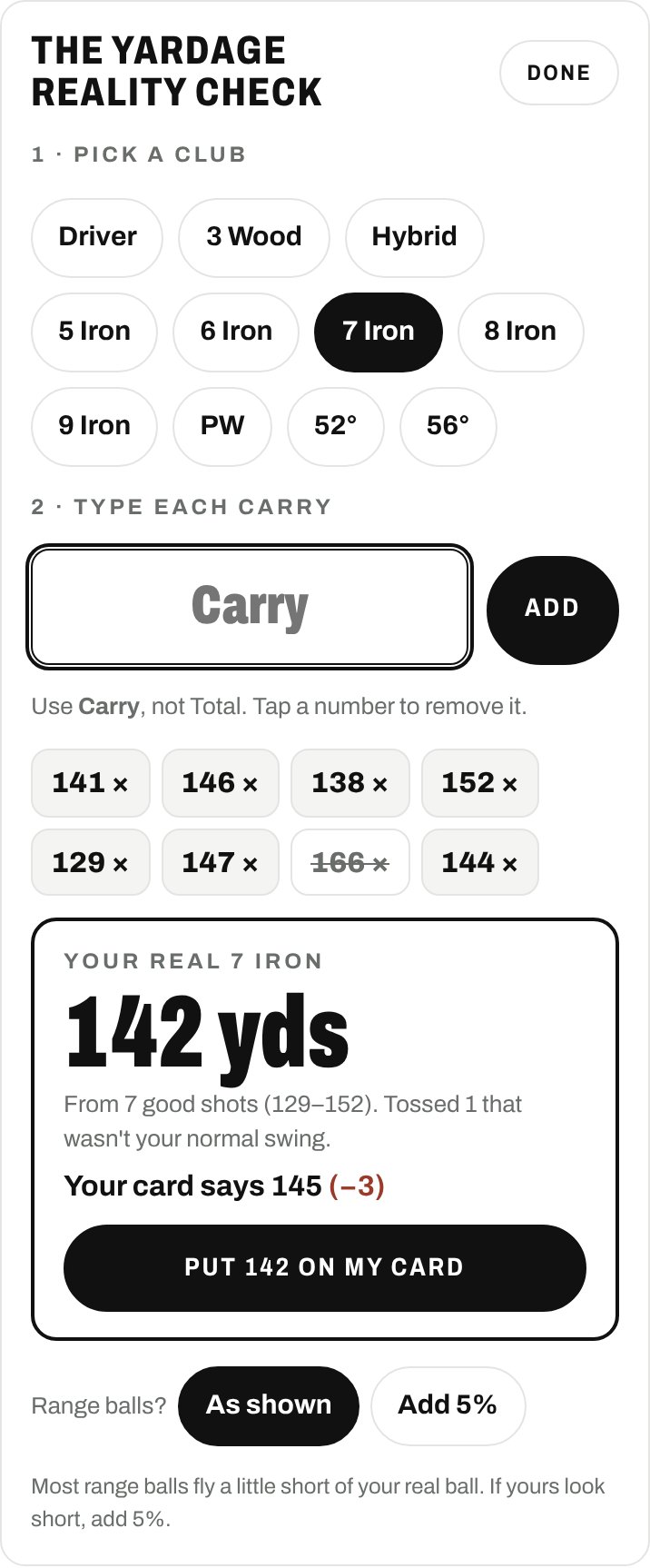
- The Yardage Reality Check. At a Topgolf bay, a Toptracer range, a launch monitor or a simulator, hit 5 to 10 balls with a club and type each carry. Pete tosses the flukes and gives you your real number.
- Pete's Yardage Card. Enter your carry distances, type the yards on the course, and Ask Pete picks the club for wind, hills and rough. Print a pocket card for your bag. Once your bag is set up, Ask Pete also shows on the hole screen.
And keep score:
- Hole-by-hole scoring with par already filled in, so a par is one tap. 9 or 18 holes, up to 4 players on one phone.
- Works with no signal, and you can add it to your Home Screen like an app.
- An unofficial handicap after 3 rounds.
What it doesn't do: it doesn't give GPS yardages, it doesn't track shots with sensors, and it doesn't tell you what clubs to buy.
Find out how far they really go. Keep score and build your yardage card in your phone's browser, for free. No download, and no sign-up to start. Keep score free
Beginner golf equipment FAQ
What clubs does a beginner golfer need?
A hybrid or wood, a few irons, a pitching wedge, a sand wedge and a putter. A driver is nice but optional at first.
How many clubs can you carry in golf?
14. Carrying more costs two strokes per hole in stroke play, up to four strokes for the round.
Should a beginner buy used golf clubs?
Yes, often. Check that the grips aren't worn, the shafts are straight, the heads aren't cracked and the irons match.
What shaft flex should a beginner use?
Most beginners start with Regular or Senior flex, or Ladies flex for many women. Flex labels vary by brand.
Do I need golf shoes?
Not to start. Spikeless golf shoes or sneakers with good grip are fine at many courses. Check the course's rules.
What golf balls should a beginner use?
Inexpensive or used balls. You'll lose some, and premium balls won't help much yet.
Do I need a rangefinder?
Not yet. Learn to use the course's yardage markers and sprinkler heads first.
Pete's Beginner's Guide to Golf: 110 pages on tee times, etiquette, the rules you'll actually use, the lingo and keeping score. Free when you join the Legend List.
Free PDF. Confirm your email to get the book. Unsubscribe anytime. Privacy · Rather hold it? Paperback and Kindle are on Amazon.More from Pete's Blog: The golf rules you'll actually use · Golf etiquette and pace of play · Scrambles, best ball and other formats · How is a golf course laid out? · What's a good golf score? · How to keep score in golf · Skins and Nassau, explained · How far should you hit each club? · How is a golf handicap calculated? · What's a snowman in golf?
IF YOU KNOW, YOU GOLF.